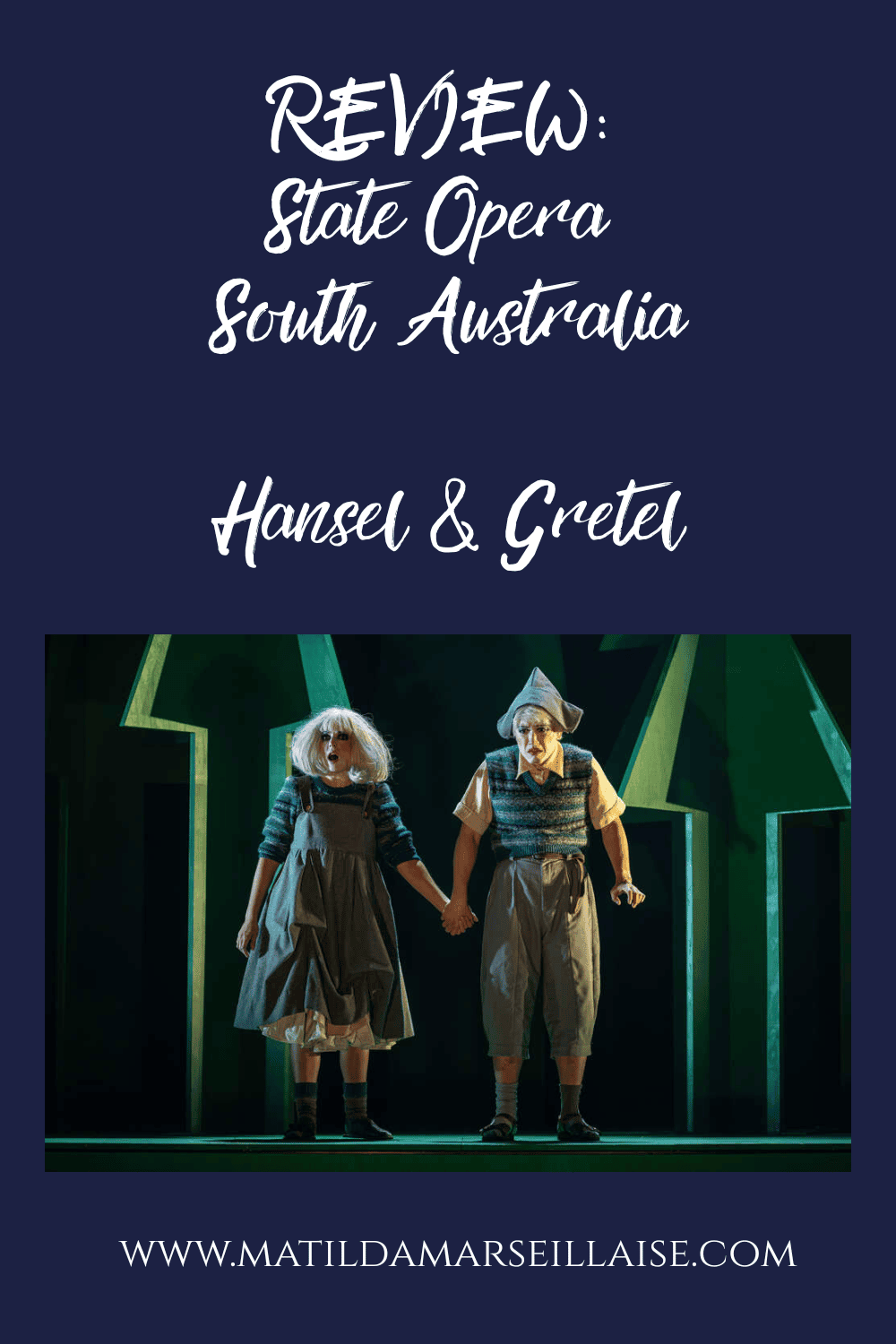
In State Opera South Australia’s new production of Hansel & Gretel, baritone Morgan Pearse sings Peter, the children’s father – a modern, down-on-his-luck parent whose flaws are shaped by poverty rather than malice. While you may think of the Brothers Grimm and Germany when you hear Hansel & Gretel, it’s widely accepted that their story has its origins in France with Madame d’Aulnoy’s Finette Cendron and Charles Perrault‘s Le Petit Poucet both written over a century earlier.
Growing up immersed in music, surrounded by supportive parents, teachers and peers, and singing Bach cantatas throughout school, Morgan Pearse found his way to opera step by step, guided by mentors and pivotal moments, such as being cast as the Count in Mozart’s Le nozze di Figaro at the Royal College of Music. In conversation, Morgan reflects on how sacred spaces like Versailles deepen his connection to repertoire, why he fights to keep characters human on stage, and how he hopes audiences will see that, despite trauma, family and love win. Read on to discover our interview with Morgan Pearse

ABOUT MORGAN
What first drew you to opera? Were there particular singers, recordings or live performances that made the art form feel irresistible?
I was incredibly fortunate to grow up in an environment as a child with music. Whilst neither of my parents were professional musicians, I was encouraged all through primary and secondary school by them, the teachers in my life and all whilst surrounded by other kids my age passionate about music. Bach featured heavily – my high school performed all of the Bach cantatas over a ten year period and there is no better way to get someone into music than throwing them into a supportive environment where music is encouraged, cool and popular. I just wish everyone had the same upbringing!
Did you initially imagine yourself as an opera singer, or did the profession reveal itself to you step by step?
It was very much a step by step thing for me. Not to say that there are people who ‘know’ much earlier, but I definitely found my own way into the job, mainly through the mentoring of significant people.
You have described yourself as coming from a family of non-musicians. How did your family respond when an opera career began to seem possible?
Oh, I was incredibly fortunate to have a family that unabashedly saw every activity of each of the three children as worthwhile. You couldn’t ask for three kids with more disparate interests either so, that was a massive testament to my parents for sure! I think ultimately, I know now that my folks will always support me and want me to succeed. If tomorrow that means something else, they’ll be the first ones to back whatever that is!
Was there a particular performance or opportunity that made you think, “This is really my career now”?
I think it was probably being asked to step up and sing my first proper ‘big’ role when I was at the Royal College of Music – The Count in Mozart’s Le nozzle di Figaro. I was super green when I moved to London, surrounded by people with much more musical experience and doing that well, and having some important people tell me that I did was quite the thing really…I also remember several times when I’ve had a significant debut experiencing delayed amazement: famous conductors, venues, colleagues and roles – all of these feel like a job in the moment and then afterwards you realise, “gosh, I just sung at venue X with that person”, and I pinch myself.
I also remember several times when I’ve had a significant debut experiencing delayed amazement: famous conductors, venues, colleagues and roles – all of these feel like a job in the moment and then afterwards you realise, “gosh, I just sung at venue X with that person”, and I pinch myself.
You performed with the Opéra Royal de Versailles in Bach’s St John Passion earlier this year. Does performing in France, or in a historically charged venue such as Versailles, change your relationship with the repertoire?
I must say, the first time I walked into the Chapelle Royale de Versailles, time stopped for a moment. The Chapelle is almost exclusively for sacred music (the opera house next door for the other stuff) and no matter what religion you follow (if any), it is impossible to ignore the magnificence and spiritual connection in that room. Performing the Johannes Passion in such a sacred place means that my acting muscles are immediately flexed and you absolutely see the characters in this great work of art appear, I’d say even more so than in a concert hall. Repertoire like this was designed to be not just sung from a score but performed and through the declamation, move an audience. It’s impossible to ignore how a setting can be a part of that storytelling. This year was my third contract that has taken me to Versailles and I’m over the moon to be back for more Bach this coming Easter in 2027.
I must say, the first time I walked into the Chapelle Royale de Versailles, time stopped for a moment. The Chapelle is almost exclusively for sacred music (the opera house next door for the other stuff) and no matter what religion you follow (if any), it is impossible to ignore the magnificence and spiritual connection in that room.
HANSEL & GRETEL
What first attracted you to State Opera South Australia’s new production of Hansel & Gretel?
Honestly, it was the chance to work with all these fabulous colleagues and come back to Adelaide and State Opera – I couldn’t ask for a more exciting bunch of people to work with.
How would you describe Peter, the children’s father? Is he fundamentally loving, weak, frightened, irresponsible – or a mixture of all four?
He’s a human, modern father who is absolutely down on his luck. One of the central themes in this opera is how desperation and poverty erodes judgement. Peter is not a successful broom maker, his family have nothing to eat and its not looking good. He chooses, unwisely, to hit the booze and in consuming his tipple of choice, kümmel (caraway seed vodka), doesn’t present a particularly good role model for his kids, or help the family situation much either. Having consumed some kümmel for ‘research purposes’ during the rehearsal period, I can also report that kümmel is not a particularly good idea at the best of times either…
He chooses, unwisely, to hit the booze and in consuming his tipple of choice, kümmel (caraway seed vodka), doesn’t present a particularly good role model for his kids, or help the family situation much either. Having consumed some kümmel for ‘research purposes’ during the rehearsal period, I can also report that kümmel is not a particularly good idea at the best of times either…
You recently sang Mercutio in Gounod’s Roméo et Juliette for State Opera South Australia, and you have also performed Escamillo in Carmen. Having sung Mercutio, Escamillo and now Peter, how do you distinguish between a larger-than-life operatic character and a more vulnerable, human father figure?
I generally will always fight to find something in the characters on stage I portray as human and not ‘acted’. Whenever I watch theatre or opera, those are the types of characters I personally connect with.
Humperdinck’s Hansel & Gretel was premiered in Weimar but its Paris reception drew comparisons between The Grimm tale of Hansel & Gretel and French Charles Perrault’s Le Petit Poucet. Are you familiar with the latter? Do you see a connection between French literary fairy tales such as Perrault’s Le Petit Poucet and the Grimm tradition behind Hansel & Gretel?
There are some definite similarities between the two stories – children getting lost in forests that have mysterious qualities, impoverished families back home, the cunning ‘trial-like’ magic characters that confront the children. I think the connections between these two stories are profound and reflect the fact that in both of their countries of origin, the family unit was paramount and the triumphs of the Little Thumb and Hänsel and Gretel are rightly venerated. I would add though that culturally, the two stories do differ: the ogre is outwitted by Little Thumb through intelligence and cunning in a picaresque way almost like Huckleberry Finn or even Don Quixote. Overall, this same feeling isn’t as present in the Grimm story where the German Romanticism in the music and the story is much darker, more serious and danger-filled. We don’t just have a threatening ogre, but an oven as an instrument of death, the terror of the children, and even shame at their mistakes. Hänsel and Gretel definitely go on much more of a psychologically dark journey in my reading of the text.
Overall, this same feeling isn’t as present in the Grimm story where the German Romanticism in the music and the story is much darker, more serious and danger-filled. We don’t just have a threatening ogre, but an oven as an instrument of death, the terror of the children, and even shame at their mistakes. Hänsel and Gretel definitely go on much more of a psychologically dark journey in my reading of the text.
SOSA decribes Constantine Costi’s Hansel and Gretel as a “visionary, genre-bending production:”. What makes it visionary and genre-bending?
Well, you’ll obviously have to ask Con about that…without giving too much away before opening night, I think that when putting a well known story like this on stage, there are a lot of ways to perform it. What I hope audiences see is a faithful depiction of the fairy tale, but some darkness, some comedy, some beauty, and some honest moments of humanity.
What I hope audiences see is a faithful depiction of the fairy tale, but some darkness, some comedy, some beauty, and some honest moments of humanity.
The opera is being presented in the same season as Sondheim’s Into the Woods. Does that pairing affect how you think about the Grimm fairy-tale world of Hansel & Gretel?
If you had to pick any companion piece to a fairy tale, I’m not sure there is a more appropriate one to pick – Sondheim’s Into the Woods is well known for being inspired by many different fairy tales and spinning them into something entirely different – Perfect!
What have Constantine Costi and Jonathon Oxlade brought to the world of the opera?
This is my first time working with either of them, so with just that to go on, I’m delighted to report that we have a stunning looking set, beautiful costumes and most important of all, a collaborative and imaginative workplace where (hopefully) we are going to produce some wonderful opera for you to come and see.
What do you hope audiences will feel towards Peter by the end – not simply whether they forgive him, but whether they understand him?
I’m not sure there is anything to forgive Peter for. The didactic lesson of this opera for me at least, is poverty has driven both mum and dad to desperation, manifested by the father’s drinking and mum sending the kids into the forest to collect berries to have a moment of peace. The seductiveness of the gingerbread house to the children as an easy, comfortable solution to hunger is the wrong one. In that moment though, its the poverty that has put all of the characters in this situation. By the end of the opera, I hope that audiences see that the cooperation of the two children in killing the witch and the cooperation of mum and dad in finding their children brings the family unit back together. Despite all the trauma everyone has experienced, family and love win.
By the end of the opera, I hope that audiences see that the cooperation of the two children in killing the witch and the cooperation of mum and dad in finding their children brings the family unit back together. Despite all the trauma everyone has experienced, family and love win.
Why should people come see SOSA’s Hansel and Gretel?
It’s a beautiful story, with some absolutely cracking music; Humperdink was a student and eventual assistant to Wagner and the orchestration is large, multi-layered and full of themes and leitmotifs linked to the characters. I would also argue that it has an appeal to a wide range of ages too. Our production does have a dark and scary depiction of the witch (so perhaps not too young an audience!) but there is plenty of modernity depicted in the parents lurking in the subtext to keep a wide range of ages interested in the story. The piece is not an endurance test either – at about two hours long, with one of the most stunning duets in all opera in the middle, it’s a perfect night out.
—
We thank Morgan Pearse for this interview and can’t wait to see Hansel & Gretel this weekend
KEY INFO ON HANSEL & GRETEL
WHAT: Hansel & Gretel
WHERE: Her Majesty’s Theatre, ADELAIDE
WHEN: 4 shows only:
- 7:30pm Friday 21 August,
- 7:30pm Tuesday 25 August,
- 7:30pm Thursday 27 August, and
- 7:30pm Saturday 29 August 2026
HOW: Purchase your tickets via this link
HOW MUCH: Full priced tickets range from $79 to $199. There are $35 tickets available for under 30s.
Which fairy tale would you like to see as an opera?