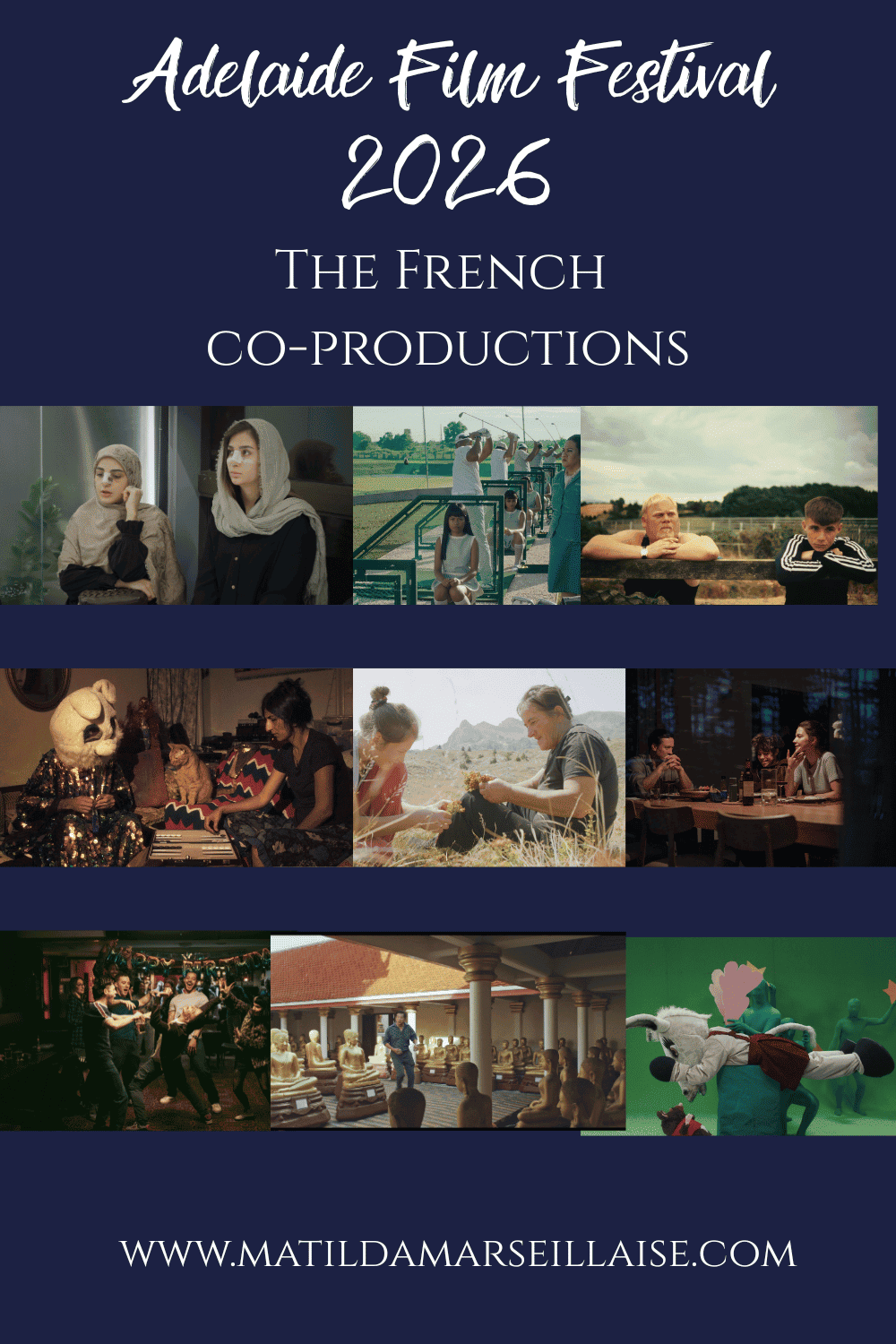
Ahead of Adelaide Film Festival 2026 opening this week, we speak with CEO and Creative Director Mat Kesting about the 122-film program, the balance between master filmmakers and bold new voices, and the festival’s growing international profile through Adelaide Goes to Cannes. We also discuss its French and Francophone offerings, from the Saturday night party film Jim Queen to A Man of His Time, Autokar and the French co-production behind Fatherland. Read on as we discuss the program, French cinema and why Mat Kesting believes in the power of the big screen.

You’ve put together a program of 122 films for Adelaide Film Festival. How many films do you think you’ve watched in the past 12 months with a view to deciding if they would be in the festival or not?
Oh, gosh. My colleague and I, we tried to quantify that a while ago. It’s hundreds. I would estimate personally over 400. It’s always nice or going to a festival to preview work; seeing it in a festival setting but there are many films that come to us by preview link now. And there are submissions too, so including shorts, we had nearly a thousand submissions this year. There are a lot of films to work through.
I had noticed that you receive films via submission as well as from attending film festivals. I assume you also have filmmakers or distribution companies saying, “hey, we’ve got this film, do you want to put it in your festival?”
That’s right. And we also commission work as well through our Investment Fund You’d remember a few years ago we commissioned Carmen directed by gorgeous, beautiful French boy, Benjamin Millepied.
Do you kind of have a fixed percentage that you have to choose from submissions or is it all fairly flexible within the realm of you’ve got maybe 120ish films.
We take the best films that we can to provide an entertaining, informative program for our audience here, as well as trying to push the art form, and show the real breadth of cinema art from around the world. So, our curatorial approach is to present a number of big films with, with known cast and, you know, that might excite people that don’t normally engage with cinema, but then also have a real breadth and depth to the program with films from all around the world.
We take the best films that we can to provide an entertaining, informative program for our audience here, as well as trying to push the art form, and show the real breadth of cinema art from around the world
So, when you’re watching a film and you’re considering whether to put it in the program or not, what are you looking for?
Well, a whole number of things. In the first pass, it’s whether it’s a good film. And having done this for nearly 30 years now, you can sort of shorthand that pretty quickly. And then in the second pass, it might be that we need more music documentaries or it might be that we need more films from a particular part of the world or we’re really lacking in comedy so, we’ll go on the hunt to prioritise finding comedy for a particular genre. So, it’s a complex task curating a festival, and also ensuring there’s lots of representation so everyone within the audience feels they can connect with the program too.
it’s a complex task curating a festival, and also ensuring there’s lots of representation so everyone within the audience feels they can connect with the program too.
You touched on just before putting in the films with the big names to draw in the people that might not normally connect with film. You’ve described this year’s program as “celebrating master filmmakers and bold new voices”. How do you weigh the established auteur against the emerging directors when you’re building the line-up?
That is a very good question. For example, in this year’s program, we’ve got we’re showing Bitter Christmas – Pedro Almodovar’s most recent film. He is highly acclaimed, well-known director, and someone that I’ve long admired. That film was a delight when it premiered in Cannes and I’m very pleased to be included in the program. But then by contrast, in the Australian independence program, you’ll find films like River, which is their second feature. An early career Australian filmmaker who’s made a really powerful film so it deserves a platform within the festival too.
So, we’re both trying to support new voices and elevate new voices in cinema, as well as offer the films that our audience expect from us as well. I think that creates a bit of magic when, the masters like Almodovar are presented alongside a first-time filmmaker.
we’re both trying to support new voices and elevate new voices in cinema, as well as offer the films that our audience expect from us as well.
Yes, how special for the first time filmmaker as well.
Yes, like I’m in a program alongside Pedro Almodovar. I think it is very special for the, the emerging filmmaker.
It would be. So, as you said, you’ve been doing this for about 30 years. You’ve been with Adelaide Film Festival prior to this role as a Program Manager, and prior to that, you were at Brisbane International Film Festival. What do you love about film and in particular about programming, film festivals?
I love cinema and I think film is still the most powerful art form humanity has to experience the world through someone else’s eyes. So, in a very short time, a feature length film, say 90 minutes, you can gain an immersive experience through that film, and understand the world through someone else’s eyes, whether that be another culture or another sexuality or from someone who may be disabled. Whatever the experience is, it’s incredibly powerful.
I think film is still the most powerful art form humanity has to experience the world through someone else’s eyes
The other thing I love about cinema, and I think this is becoming even more potent as time goes on, is the capacity to lose yourself in a film. So, when you’re in a cinema and you turn your phone off and the lights come down – for that couple of hours, you can really just forget yourself and forget all the worries you may have and be taken away with a story. I think that’s actually, from a psychological perspective, a really healthy thing to do.
These are some of the things I love about cinema and I want to share with as many people as possible. And, this year AFF is All for film, and we invite everyone to come and be a part of it. Bringing people together is actually one of the things I love the most about running a festival. It’s an opportunity to create community and bring people together. It brings me great joy actually to be building community, positively building connectivity within the community and cohesion.
this year AFF is All for film, and we invite everyone to come and be a part of it. Bringing people together is actually one of the things I love the most about running a festival.
And like you said, it’s one of the rare spaces now where for the most part, people turn off their phones and be in that world for the length of the film. How did you get into film and what made you decide to pursue it as a career?
So, I studied to media and with the view of becoming a journalist. And as part of that course, I took subjects in cinema. I started a short film festival. It was just for a little bit of fun while I was at university, but it was immensely popular and ended up becoming a national event. Through that, I got a taste for running festivals. Never did I actually think I would be able to sustain myself through working in film and film festivals, but I seem to have managed to do that!
Never did I actually think I would be able to sustain myself through working in film and film festivals, but I seem to have managed to do that!
You were at BIFF (Brisbane International Film Festival), before Adelaide Film Festival. How do you find that the Adelaide Festival Film Festival program varies in terms of what you think South Australian audiences want or what we have access to. Do you find that they vary in terms of how you curate a festival for Adelaide audiences?
Absolutely. I’ve been working with Adelaide audiences since 2009, and feel like I’ve got a good sense of the demographics of our audience. We’re pretty special here. South Australia has an incredible array of talent in terms of the filmmakers that are working here and I’ve had the great joy of seeing some of those filmmakers transition from emerging through to now internationally acclaimed filmmakers. So, for example, the team behind Lesbian Space Princess; the filmmakers behind Talk to me; the director behind Mockbuster. There’s many that I’ve seen make that leap.
We’re pretty special here. South Australia has an incredible array of talent in terms of the filmmakers that are working here and I’ve had the great joy of seeing some of those filmmakers transition from emerging through to now internationally acclaimed filmmakers
So, in terms of what we’re trying to present for audiences here, I think there is a strong filmmaking community and I’ve always been heartened in how they support each other. But also, our local audience really enjoys seeing our own culture and our own place in the world presented on the screen. If you go back to first principles, that’s why we have a subsidised screen industry. It’s to support our own films and screen stories to be made because otherwise we would just be inundated and overwhelmed with from larger English-speaking territories.
If you go back to first principles, that’s why we have a subsidised screen industry. It’s to support our own films and screen stories to be made because otherwise we would just be inundated and overwhelmed with from larger English-speaking territories.
And in terms of nurturing the South Australian films, there’s the Adelaide Goes to Cannes initiative, which takes the South Australian films to the Cannes Film Market, which I think it may have been your initiative, but at least has started while you’ve been at the festival
That’s right. I’m really proud of that partnership. So, the Cannes Marché partners with just seven festivals around the world, and we were invited to be one of those festivals three years ago. So, we’ve run that initiative for three years and plan to continue running it as long as it is helpful to filmmakers. In the first year it was entirely South Australian filmmakers that we took. We’ve since branched it out to make it a national initiative. But we give priority to South Australian filmmakers. But the requirements for that initiative are that a film is complete or near complete, and seeking sales or further investment. So, it’s quite a specific requirement.
the Cannes Marché partners with just seven festivals around the world, and we were invited to be one of those festivals three years ago.
What we found is that it’s been really helpful in supporting films that are truly independent. So, we’re premiering a number of those films that we took to Cannes this year including Tiber, which will have its world premiere. Directed by Dominic Allen, this is an Australian film filmed in Italy, and it’s gorgeous, and an incredible achievement by Dominic. Another film, River I mentioned earlier, and Wilderness, Martin McKenna’s film; it’s fantastic. So those three will premiere as part of the festival this year.
I didn’t actually realise that you were invited to be part of the Cannes Marché; that is quite a coup.
Yes, we’re very proud to have that association. So, it’s alongside other festivals from around the world: Tokyo International Film Festival. Tallinn Black Nights from Estonia, the Africa International Film Festival from Nigeria, the Hong Kong Asia Film Financing Forum in Hong Kong, Festival do Rio from Brazil, and Ventana Sur from Uruguay. So, it’s truly international representation there. It’s with much pride that we represent Australia.
Because you would expect maybe Sydney or Melbourne. From overseas, you may well think it will be the bigger cities.
That’s right. And you know this year Australia did not have any films in official selection in Cannes. So, these five projects had significant prominence in the market. The Market is promoting all of the films associated with this initiative. It’s one of the platform initiatives. Screen Australia were very supportive of it, and put up the images from the films all over their walls in their office. It was almost like these five projects were representing Australia in Cannes this year. And alongside of that, it gave prominence to the Adelaide Film Festival, which was not the main driver behind the initiative, but it was a secondary benefit and it’s been great.
It was almost like these five projects were representing Australia in Cannes this year.
Of course. I imagine that being part of that means that distributors that may not have heard of the festival before will actually start suggesting works to you.
That’s right. Adelaide has long had a very positive profile with sales agents around the world and certainly Australian distributors that we work with all the time. But that was largely through the AFF Investment Fund. We’ve supported over 160 projects over the last 20 years, and many of those have been highly acclaimed. Most recently films like Wolfram, directed by Warwick Thornton in competition in Berlin this year; The Fox, which had its international premiere in South by South West Austin after its world premiere at AFF last year; Lesbian Space Princess, which won the Teddy Award in Berlin a couple of years ago. The list goes on.
These films have travelled the world and taken, Adelaide to the world. So, people often know us through those films. But you’re absolutely right – and it was very perceptive of you to identify this – the Goes to Cannes initiative has given profile to AFF so that when I sit down and take a meeting with a sales agent, they already know who we are, and in fact, they pay a lot of attention to the films that we select.
These films have travelled the world and taken, Adelaide to the world. So, people often know us through those films.
Good! How many film festivals do you attend in a year?
Oh, as many as I can.
As many as the budget will allow?
Yeah, exactly. So, we go to Cannes – obviously that’s a really important one. The reason it’s so important is because the market is there as well, and it’s the world’s largest market. It’s like the Olympics of cinema. It literally has an international village where you can meet with every single country from around the world, and anyone working in the business is there. So, it’s incredibly useful like that. And, also the films that are selected as part of that festival kind of become the backbone of the releases for not only this immediate year, but the following year as well.
The reason it’s so important is because the market is there as well, and it’s the world’s largest market. It’s like the Olympics of cinema.
But we also find benefit in going to Berlin, and the last three years I’ve attended Sheffield Documentary Festival, which has been really great. We try and mix it up and get to some other less anticipated, more exotic festivals. So, I went to Guadalajara in Mexico a couple of years ago. If we can stretch the money, we will. I’ll go anywhere in the world.
So now, we need to speak to you a little bit about the French elements in the program. So, you’ve chosen Jim Queen as the Saturday night party film. What made you decide that was the perfect film for the Saturday night party event?
Because it is so much fun. It is a party film.
It looks hilarious.
When I previewed this, I was belly laughing throughout the whole film, and literally had laugh cries going on. It’s a true celebration, so in terms of setting the tone for a party, it’s a perfect selection, I think. What we’ve tried to do with that Saturday night slot in the middle of the festival is choose films that we know are really great, and that are going to have a bigger life, but that audiences may not be fully aware of. So, we presented the Australian premiere of Emilia Perez, and then last year, we showed Sirat, which after that was one of the Oscar nominees. and certainly had a bigger life. So, they’re films that will literally blow the audience’s mind away.
When I previewed this, I was belly laughing throughout the whole film, and literally had laugh cries going on. It’s a true celebration, so in terms of setting the tone for a party, it’s a perfect selection
In any film festival program, there are always some films which are only in French; and then because the French love co-productions, there will often be some where French is just one of the languages or where France is involved, probably in some financing but isn’t actually related to the language or the setting. In AFF 2026, you’ve got A man of his time from Belgium and France, obviously Jim Queen that we just spoke about but you’ve got some shorts from Belgium, which are without dialogue, such as Autokar. How significant a role does French and francophone cinema play into your thinking when you’re building the program?
France is the birthplace of cinema, and remains one of the strongest places of production in the world. That is partly because of the policy settings in that country, but it is also because of the deep appreciation of cinema. Cinema is part of daily life for French people. We were talking about the Cannes Film Festival before. Sometimes I feel like it is like going to Mecca. I go there and have my tyres pumped up, and charged up to go back out into the world and promulgate screen culture and our love of it. We go back to that place to drink from the fountain and be charged up.
Cannes Film Festival […]Sometimes I feel like it is like going to Mecca. I go there and have my tyres pumped up, and charged up to go back out into the world and promulgate screen culture and our love of it. We go back to that place to drink from the fountain and be charged up.
The films that we’re showing from France, as you mentioned, are either French stories, or more and more, everywhere in the world, it’s becoming difficult to make films – to finance and complete them – so it’s not unusual to see co-productions. Europe has been very good at co-producing films for a long time now so you’ll often see France listed as a country against a film that you may not necessarily anticipate it to be. Fatherland is a good example of that. It’s a Polish director, German story but has French money in it, and was one of the hits in Cannes this year.
And talking of hits at Cannes. You’ve programmed two films, each of which won both of their leading actors and actresses, respectively, the best joint actor or actress award, being Coward and All of a sudden. I’m really looking forward to seeing those. How important is it for you to have award winning films in the line-up?
It is very important. I think that is one point of entry for audiences. So, there are a lot of things in the festival and, if people are just looking for a way to prioritise what they see, they can do it by the films that have won awards.
What are your must-see films at the festival this year? Because obviously you can’t see everything.
Well, you know, I’ve shortlisted them in a 64 page document, which I encourage everyone to have a look at!
Haha, that makes it easy for the lay person!
Seriously, I know that there is a lot, and it’s impossible to see all the films, so I really encourage people to download the app, and spend some time reading about the films. You can create a wish list and, and from there, narrow it down. The other way to do it, and I often do this with festivals, whether it’s film or any other festival, is to go through and identify when you can actually go, and book your tickets that way. So just throw yourself into a session around randomly. You’ll have a great experience.
—
We thank Mat Kesting for this interview and cannot wait for Adelaide Film Festival 2026 to open this week!
KEY INFO FOR ADELAIDE FILM FESTIVAL 2026
WHAT: Adelaide Film Festival 2026
WHEN: 14-25 October 2026
WHERE: Various cinemas in Adelaide
HOW: Purchase your tickets via the links above. Or, if you want to see multiple films, or there are several of you going to any one film, you may wish to purchase a Film Pass.
HOW MUCH:
Individual ticket prices are as follows:
Standard Screenings (exclusive of booking fee):
- Adult $25
- Concession $20
Saturday Night Party (exclusive of booking fee)
- $74 Full Price
- $64 Concession
Film Pass pricing (exclusive of booking fee):
3 Film Pass – $59 Full Price, $49 Concession
Valid for 3 standard screenings, or can be used for up to 3 tickets for a single session.
5 Film Pass – $95 Full Price. $79 Concession
This pass is valid for 5 standard screenings. Book up to 3 tickets per session.
10 Film Pass – $175 Full Price, $145 Concession
This pass is valid for 10 standard screenings. Book up to 4 tickets per session
Gold Pass $299 Full Price, $255 Concession.
1 ticket to all standard screenings, standby priority and an official AFF Lanyard
NOTE: You still need to book your spot in each session you wish to attend – the pass alone does not guarantee a seat
Platinum Pass $599 Full Price, $525 Concession.
The blockbuster of passes!
1 ticket to all standard screenings and galas, select party and event invitations, standby priority, concierge booking service, and an official AFF lanyard.
Pass benefits are non-transferable and tickets must be booked to guarantee a seat.
OTHER TICKET OPTIONS
Pay what you can – students, Centrelink Health Care and Pension card holders
Equity ticketing is available for weekday sessions before 4pm. You can purchase them in the app or online and simply pay how much you choose to.
AFF Rushes
$10 tickets will be released at midday every day of the festival on the AFF app.